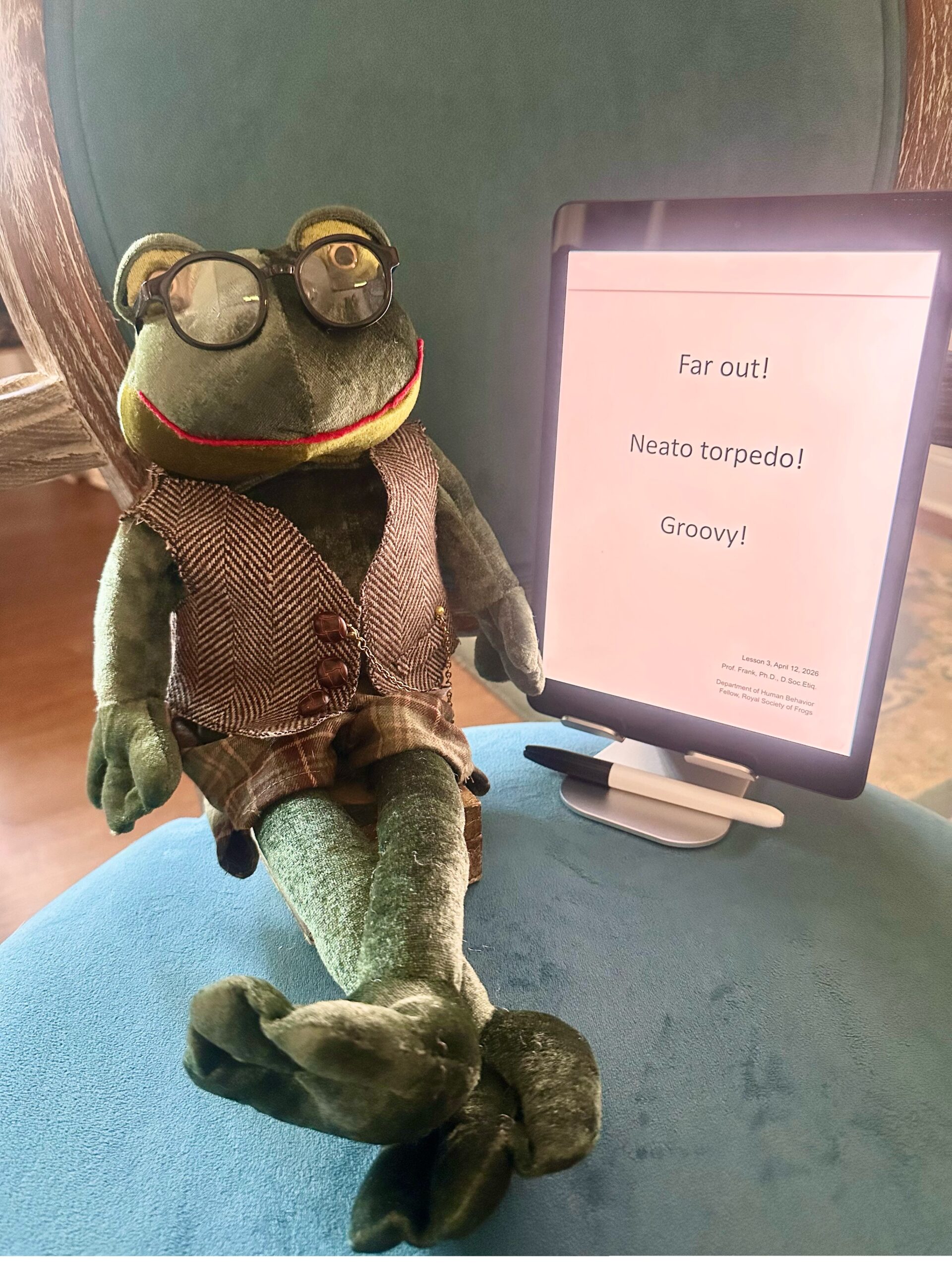

Hey, it’s Frank!
Here’s a little story I thought you’d enjoy, so get to reading!
You may not know that I often accompany Jane to church. As a frog of considerable spiritual and liturgical experience, I consider it important to attend. Plus, I’m good at absorbing needed information.
So, I’ll tell you about my Sunday experiences. I typically ride there inside her handbag beside sunglasses, lipstick, her mother’s vintage embroidered hanky, a folded bulletin from several Sundays ago, and one peppermint that has escaped its wrapper and become part of the purse lining permanently. I am, however, an expert at the extraction of those sorts of things and do so immediately as we head down to John’s Island.
Now, before anyone starts imagining Jane drifting toward church in a cloud of chiffon after six costume changes, let me say that one socially confused young woman implied something along those lines last year and it was deeply inaccurate. Bless her heart. Jane does not “dress for church” in the dramatic sense. Certainly not in chiffon, unless it’s a wedding. She simply dresses according to Kinard standards, a deeply held family thought that one must wear your best when standing in God’s house. Therefore, on those mornings while getting ready, Jane mostly wanders around holding one earring saying “Where on earth is the other one”.
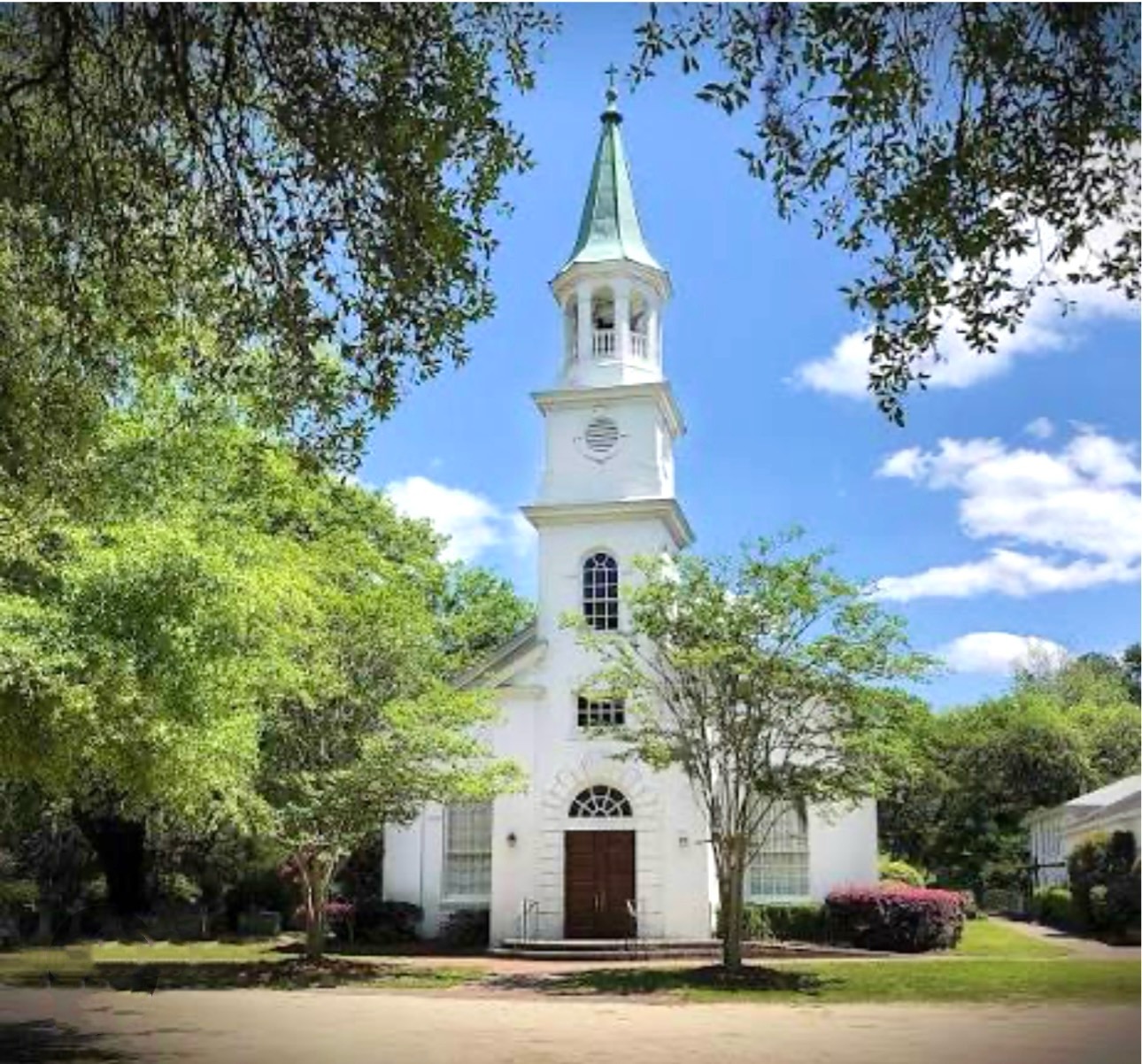
Upon arrival at St. John’s Episcopal Church, I take it all in. Honestly, it is so beautiful that people with no connection whatsoever routinely decide to get married there after one look at the live oaks and the dripping moss. Just look at the photo. I mean really, wouldn’t you want to vow eternal love in a place like that?
Little do they know they’re walking into a place that has seen wars, hurricanes, funerals, marriages, casseroles, choir anthems, reconciliations, babies, heartbreak, and generations of people trying to figure out God.
The church has been there since 1734, but not continuously, obviously. The British and the Civil War had opinions about that. Still, the place feels rooted in a way that’s hard to explain. Old churches carry history in a different way, and St. John’s certainly does, even through seasons of change and division in recent years. Which may be part of why it feels so meaningful now to see the old Episcopal church so alive again, with children everywhere, committee meetings, Bible studies, music rolling through the sanctuary, and people gathering once more beneath those live oaks to pray, sing, worship
A great deal of that renewed life seems to flow naturally from Callie herself, who somehow manages to be deeply thoughtful and well-read without a trace of folderol about it. (She’s the rector of St John’s). She speaks plainly, listens carefully, runs gatherings transparently, and carries herself with the calm confidence of someone who understands both people and the rhythms of an Episcopal church. One moment she is discussing theology, the next she is standing in the parish hall having an actual conversation with a parishioner (whoa, who’d a-thunk it!) instead of simply greeting them and moving along, somehow making each person feel genuinely seen and welcomed.
So, we arrived, and there was already a man in a bow tie standing in the narthex handing out bulletins. Darling of a man. Jack. Some things are so comforting.
The flowers at the altar looked superb this morning, and slightly less formal than some arrangements tend to be. These looked like they might occasionally hear birdsong and make their own decisions. Perfection.
Anne had already started the organ prelude, and the second you glimpse that white hair over there at the organ bench, you relax a little. Whatever size the organ may or may not be compared to grand cathedral situations becomes irrelevant almost immediately because somehow she pulls warmth and grandeur and mystery out of every last note anyway.
Then Tim came in with the trumpet. He travels what feels like half the state to play with us. Swoon we do. By the final verse, everyone suddenly holds their heart like they’ve personally survived hardship. Somewhere around the last phrase, you begin forgiving people from the year 1997. Several folks looked emotionally repaired.
The choir sounded wonderful this particular morning. The descant on the last stanza, glorious! They’re earnest, joyful, and fully committed, which is really all anyone can ask of church music or most of life.
The LaRoches were seated near the front as always, she in her wheelchair looking elegant and composed. They have that calm Ninety-Six, South Carolina energy. Jane, naturally, is of Kinard stock too. Actually, at least a third of the people in our pew seem connected somehow through Kinards, marriages, middle names, or deviled egg lineage. At some point it stops being a pew and starts becoming a family diagram.
Meanwhile Bess and Lee had arrived with Jane’s grandbabies. Lee sat reverently as usual with the calm church decorum that comes from descending from a long line of clergymen. Even his disapproval at any pew shenanigans looks Episcopal.
Jane and Bess immediately became distracted by an extremely ambitious hat several pews ahead and began whispering observations back and forth while Lee gave slow disappointed head shakes without fully turning his head.
The children cycled through the normal Episcopal child sequence: standing, kneeling, drawing, dropping crayons, asking for water, deciding against water, staring at candles, and folding bulletins into unrecognizable shapes.
Then Henry scrambled to stand straight up in the pew, pointing dramatically toward Tim, and yelling: “THAT’S A TRUMPET!” Not once but several times with increasing excitement each time. Honestly, he was saying what everyone else was feeling.
There are, though, certain hymns one quietly hopes do not appear too often in the rotation, and Hymn 435, “At the Name of Jesus,” remains high on my personal watch list. So far as I know, it has not yet been sung at St J’s. Its melody line gives the impression of having received troubling news midway through composition and never fully recovering.
Another hymn, however, was on this occasion so familiar and triumphant that Jane nearly swirled herself out of the pew to dance down the aisle. I prepared myself to follow in two dignified frog hops.
Rebecca was operating the livestream camera in the back, and I continued having the excellent idea that Jane should sit directly in front of the tripod and occasionally pop up with googly eyes, at close range, to wave pleasantly to online viewers. We love planning this sort of thing. However, as she and I discussed the plan, Lee discouraged this idea entirely through facial expression alone.
One of the readers has pronunciations so calm and accurate that your shoulders immediately relax. She’s a beautiful woman with long curly hair who always reads so well. No strange biblical improvisations. No dramatic vowel experiments. No “Galilaaaaaay-ah.” Just clarity. Competence. Peace. (I should also say that I hope none of you are unexpectedly assigned to read Isaiah 8:1 anytime soon because once you arrive at “Mahershalalhashbaz,” the entire church will develop a visible atmosphere of concern.)
Then came the Gospel. Down the center aisle John stood and read it with much animation and humanity. Suddenly you weren’t listening to Scripture anymore so much as standing there outside Jerusalem, on a dusty road, in your sandals, with heat and crowds and voices all around you.
I gave two discreet frog leaps during this portion because the spirit moved me. Callie was stepping into the pulpit, and with that, I always make my way front and center so I don’t miss a word. Now when Jane folds her bulletin shut, scoots forward slightly, and folds her hands in her lap, you know she’s interested. Jane and I agree that one of our favorite sermon of hers, is the one in which Callie talked about horseback riding in Mexico at Xotolar Ranch, just outside San Miguel de Allende. Jane had been there with her. She talked about the gripping of reins too tightly in distrust of the trail ahead. And then quietly, without anybody quite noticing when it happened, the sermon stopped being about horses. The horse already knew the trail. The horse had been there before. Don Tomas had trained him. The fear came from not trusting what was carrying you. And suddenly the whole thing became about God and fear and surrender and trying to loosen your grip enough to trust guidance when you cannot fully see the path ahead.
Her sermons are like that. She brings in poetry and trees and injustice and dogs and grace and human longing without losing the thread for even a second. The entire church leaned inward. There are sermons where people politely listen. (The speaker working to be lofty, me thinks). And then there are sermons where people suddenly get very still because they realize: “Oh. This, so thoroughly, applies to me.” And I’m so grateful to be hearing this.
Afterwards, communion was about to arrive and I leapt through the kiddos to reach little David, so I could hear him as he says the Lord’s Prayer. 5 years old. Always a tearjerker moment. Then, the grandchildren were involved in whispered emergency instructions all down the pew. “Arms crossed means blessing.” “No grabbing.” “You must actually chew it.” “Not later.” “Yes now.” “No saving it.” The children listened with the seriousness of people preparing for international travel. Then we all shuffled forward together: small shoes, careful hands, parents, grandparent, children moving slowly toward the altar while the organ rolled.
And ultimately, the recessional. Dear Lord. Anne and Tim absolutely lifted the roof off the place. The organ swelled. The trumpet rang out. The hymn surged forward. At that point, remaining seated no longer felt spiritually correct.
So, with several discreet frog leaps and a whispered series of “excuse me… terribly sorry… pardon me…” I made my way out of the pew and joined the very end of the recessional behind Callie herself. I straightened my little plaid waistcoat, lifted my chin with quiet ecclesiastical dignity, and fell into step. Although solemn and reverent, every few steps, a tiny buoyant hop betrayed my excitement. I nodded graciously to various parishioners like visiting amphibian nobility. There was Lisa, Callie’s mother, whom I adore. A special nod for her. A warm acknowledgment for Jack, the bow tie gentleman. A respectful backward glance toward the LaRoches. And onward we all moved, carried along by a blessing and the comforting feeling that none of us were trying to find the trail alone.
Love,
Frank